
Seven Things We Would Lose If We Gave Up Our Modern Worship Songs for ONLY Hymns
Written as critical thought, in the similarly stifling spirit of: 5 Things You Lose When You Give Up Your Hymnals
- We would lose a body of songs originally written for Worship. Many hymn melodies first existed as secular songs. They are adopted folks songs, and even bar tunes – literally new wine put into old wineskins. Modern worship song melodies exist as new wine in new wineskins. They are exclusively written with corporate worship in mind.
- We lose a deep knowledge of our songs. We have a hear-say understanding of the story behind some of the hymns, but the authors of these songs are long gone, no longer able to appear on a podcast or share their life and stories with us on social media. Did you know some “beloved” hymn writers participated in the slave trade and honed their lyrical skill writing naughty limericks. We have no way of asking them to account for these lapses, and it’s difficult to find assurance they put this life aside. When modern songwriters have a lapse of faith, we know about it immediately.
- We lose the ability to create new harmonies. Hymns, with their codified notes, mandate a certain harmonic voicing. This amounts to loosing the heart of harmonic expression. When was the last time someone was able to improvise from a hymn book based on how God was speaking to them and working through them? Why must we be slave to a voicing dictated decades or even centuries ago? Today, vocal rehearsals allow for fresh inspiration based upon individual gifting and the moving of Gods Spirit.
- We lose the ability to sing skillfully. An acceptable rendition of a hymn requires only the vain repetition of notes and words. Nowhere is the Spirit expected to enter into the worshiper and inspire them to create something fresh. In fact, such a display might be deemed inappropriate. A mathematically accurate rendition is sufficient. Conversely, modern worship songs invite and even require personal expression. They welcome fresh instrumental arrangements and relish in the moving of the Spirit to facilitate corporate worship.
- We lose the ability to have the songs in our home. Not everyone can afford a piano and can maintain it properly, and not everyone has access to a piano player. But with the ubiquity of smartphones, and a modern streaming service, we have virtually unlimited access to worship songs of all styes and even languages in our home, car and workplace 24/7. Bringing even a small accordion on our commute is not recommended, even with our Tesla on autopilot.
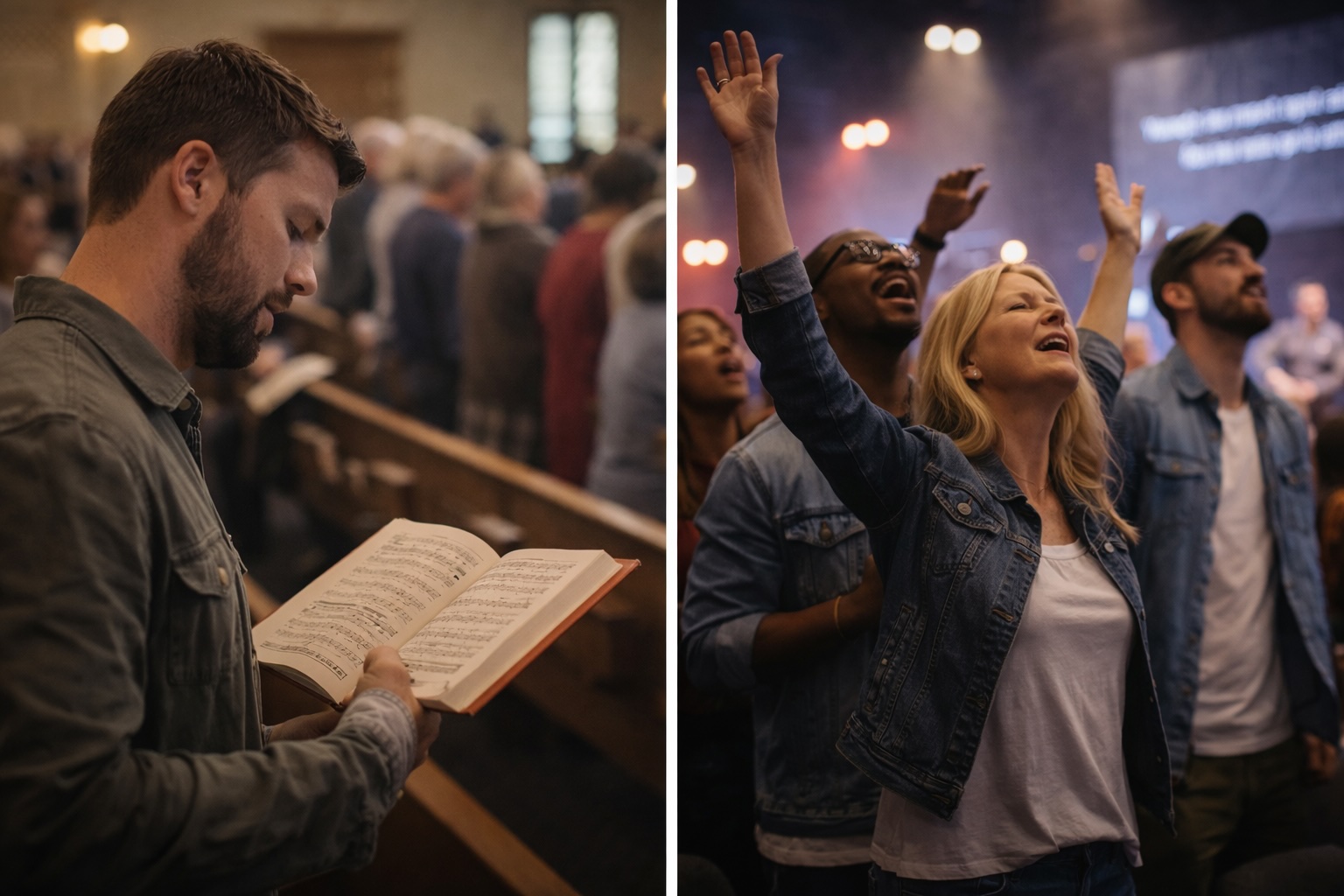
- Mechanically, hymns require a hymnbook and specialized knowledge. Hymns have complex lyrics and melodies which require print resolution to adequately display. Hymns ask a congregation to bury their heads in a hymn book. Modern worship songs are designed to be melodically memorable and do not require specialized knowledge of music for participation, nor are they lyric heavy. Modern projection of simple lyrics can leverage those memorable melodies and invite us to life our heads up, in communion with one another, and in worship of our God.
- The scriptures admonish us to “sing a new song”. We simply can’t do that while resting on our laurels and pretending like the creative work of writing praise songs was completed two hundred years ago. “For Jesus did many other things as well. If every one of them were written down, I suppose that even the whole world would not have room for the books that would be written”. Do we believe that or not? Do we believe God is still moving today? If we do, we need to continue to provide a platform for God to continue to move among a new generation of worshipping songwriters.
p.s. I’m not going to say it’s unbiblical to sing an old hymn, but unless if you’ve included a Chris Tomlin-like bridge, it kinda is.